Wednesday, October 19, 2016

New LoRa modules from dorji.com

Santa Claus came early this year for me with 10 great modules from dorji.com. You can buy them easy on tindie,com , ebay.com or give them an email.

Modules are based on SX1276 chip have the code DRF1276G with the full specs:

  •  (G)FSK/4(G)FSK/LoRa Modulation
  •  868/915MHz transceiver
  •  20dBm output power
  •  -139dBm sensitivity
  •  Standard SPI interface
  •  127dB dynamic Range RSSI
  •  Automatic RF sense and CAD monitor
  •  Data Rate: <300 kbps
  •  Standby current: <1uA
  • Supply voltage: 1.8~3.6V


Dorji DRF1276G LoRa 868Mhz modules

Comparing them with other modules I have, from niceRF, the space between the pads is 2mm versus 1mm on niceRF so there is more easy to solder them on. Also have pins on both sides so is much easy to design a good PCB. See a picture with the niceRF LoRa module.

niceRF SX1276  v1.1 868Mhz LoRa module


I will connect them to the ESP8266 on the SPI I will let you know about the progress.

You can connect them to this ESP module or this one which is battery operated (keep in mind that are 3.3V modules) and don't forget to read this post.

Another nice thing abut this modules is that you can use them as a single channel gateway for LoRa so you will make an economy of few hundred euros so you can buy more modules and test or deploy your network.


Finally my LoRa gateway will be happy to receive another 10 motes. I am waiting for ideas what to connect as sensors for  nodes. 

Other software I am working on is a new LoRa Network Server that will be deployed as SaaS into the cloud so anyone can have a LoRa Server in a matter of minutes. With this server will be very easy to deploy your private LoRa network.

As a status, the Rx (uplink) part is done and I am working now on the TX ( downlink).  The network server will support for the beginning the latest version (2) and I will add previous version (1) later on.


My LoRa Gateway

Wednesday, October 12, 2016

ESP32 now on preorder


Good new today !!!


Today the ESP32 is on preoder on banggood. Delivery will start by the end of October.


If you are in the first 50 orders $7.69, up to 200 $8.69 and $9.69 after that.


As a reminder the specs from the official espressif site are:


Key Features

  • 240 MHz dual core Tensilica LX6 microcontroller with 600 DMIPS
  • Integrated 520 KB SRAM
  • Integrated 802.11BGN HT40 Wi-Fi transceiver, baseband, stack and LWIP
  • Integrated dual mode Bluetooth (classic and BLE)
  • 16 MByte flash
  • 2.2V to 3.6V operating voltage
  • -40°C to +125°C operating temperature
  • On-board PCB antenna / IPEX connector for external antenna


Sensors


  • Ultra low noise analog amplifier
  • Hall sensor
  • 10x capacitive touch interface
  • 32 kHz crystal oscillator


32x GPIO


  • 3 x UARTs, including hardware flow control
  • 3 x SPI
  • 2 x I2S
  • 12 x ADC input channels
  • 2 x DAC
  • 2 x I2C
  • PWM/timer input/output availabe on every GPIO pin
  • OpenOCD debug interface with 32 kB TRAX buffer
  • SDIO master/slave 50 MHz
  • Supports external SPI flash up to 16 MB
  • SD-card interface support


Security Related


  • WEP, WPA/WPA2 PSK/Enterprise
  • Hardware accelerated encryption: AES / SHA2 / Elliptical Curve Cryptography / RSA-4096


Performance


  • Supports sniffer, station, softAP and Wi-Fi direct modes
  • Max data rate of 150 Mbps@11n HT40, 72 Mbps@11n HT20, 54 Mbps@11g, and 11 Mbps@11b
  • Maximum transmit power of 19.5 dBm@11b, 16.5 dBm@11g, 15.5 dBm@11n
  • Minimum receiver sensitivity of -98 dBm
  • 135 Mbps UDP sustained throughput
  • 2.5 μA deep sleep current

Monday, August 29, 2016

DS18B20 temperature sensor and ESP8266

For a small project I had to measure temperature with some waterproof sensor and of course that my first choice was the DS18B20 waterproof sensor and for microcontroller an NodeMCU because I needed also the web server functionality. 


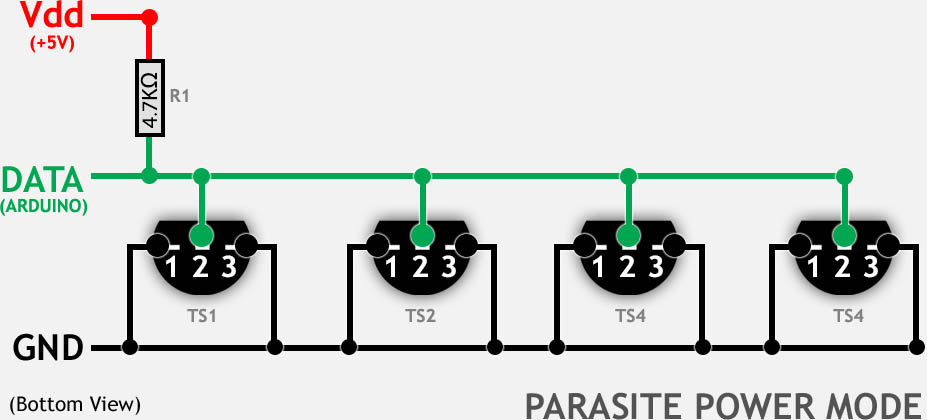
The DS18B20 sensors doesn't have the pull up resistor so I've added one with 4K7 value between DATA and VCC.

The fun is that adding only one sensor I couldn't read its value, but adding two of them in parallel everything was perfect. I've changed the pull resistor in range 1K to 9K4 , I've added a capacitor of 100nF between VCC and GND like it is in this module ( which by the way is working perfect alone with not other sensor in parallel).

Using the same library and sensors with Arduino works perfect, so it looks like my sensors have a problem ( all three of them) or the library need some adjustments for the ESP8266.


Lucky me that the project involved two DS18B20 sensors so for now I will use them like this.

Conclusion: If you have the same problem as I did just add another DS18B20 in paralel.


Picture from http://www.tweaking4all.com/


PS: I also tried the parasite mode ( is using only 2 wires instead for 3) but I had the same result.


Picture from http://www.tweaking4all.com/


To do: Connect this module with an 1 meter cable and check if is still working.

[ Later Edit ]. Looks like the probes were defective. After I've changed them everything is working now. I can connect one or more then one without problems.

Saturday, August 27, 2016

A good book about ESP8266

One thing that I did in the last two months was to collaborate with Packt Publishing to be technical supervisor for a book about the ESP8266.

Book is written by Marco Schwartz and can be purchased from Amazon.

The summary of the book is in the following pictures.


Friday, August 5, 2016

Mqtt broker on ESP8266 #4


[Later edit]. On iotcentral.eu you will find instructions on how to install the ESP8266 MQTT broker on your EPS8266 and how to use the MQTT service provided by iotcentral.eu


I have more progress in ESP8266 as MQTT broker.


What I have for now on this ESP8266 module:


  • MQTT broker functionality
  • Bridging data to/from and another MQTT broker ( usually a cloud MQTT instance)
  • websockets connectivity ( I can now connect with my Homy application directly to the ESP8266 acting as an MQTT broker)
  • OTA (Over The Air) updates. Every time I have a new software update the ESP8266 is updating itself so, I can say that I have continuous integration (CI) and continuous deployment(CD). Also all the modules are activated over the air.
With all those function in place I still have 34kb of heap available for other features and yes is running on an ESP with a minimum 1Mb of memory. ESP8285 is a good candidate for running the broker.

Is working also on and old ESP-01 with 512kb but without OTA functionality.

Previous posts on the same subject:


IoT with ESP8266: Mqtt broker on ESP8266 #1